30.11.10


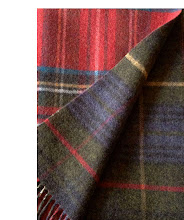
Living: The Stewart throw, possessing
a distinct flavour akin to The 39 Steps,
with or without H.P. Sauce.
Available at Ancient Industries.

29.11.10

Extinct: Non pictorial advertising.
"Street Advertising" by John Thomson,
from Street Life in London, 1876-8.

24.11.10

Extinct: The earlier settlers.
Indian Creek State Park, Utah.
Photograph by David Hiser.

23.11.10

Living: The mince pie.
Once known as the Wayfarer's Pie,
this is an early portable food, often
thought suitable for Father Christmas.

22.11.10

Living: Vogue magazine, established 1892.
Thanks Vogue for featuring Ancient Industries
in the Christmas Gift Guide.
Design and photography by Irving Penn, 1946.

19.11.10

Living: D. I. Y. Enchanted Cottage

18.11.10

Three Strap Boot, a Civil War style

Newmarket Boot, a summer field boot

Living: E. Vogel custom made boots since 1879.

17.11.10

Extinct: W. H. Grindley & Co., established 1880,
Stoke-on-Trent. Went into receivership 1991.

16.11.10

Elizabeth Siddal in a sketch for Ophelia
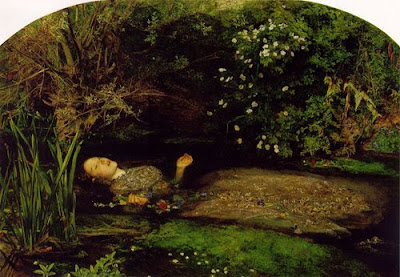
Ophelia by John Everett Millais, 1852

Extinct: Fowler's Solution.
"Well into the nineteenth century, many women
drank a concoction called Fowler's Solution, which
was really just dilute arsenic, to improve their
complexions. Dante Gabriel Rosetti's wife,
Elizabeth Siddal was a devoted swallower of
the stuff, and it almost certainly contributed
to her early death in 1862.*

*Overcome with grief, her husband buried her
with a sheaf of poems that he had failed to copy;
seven years later he thought better of the gesture,
had the grave dug up, and retrieved the poems,
which were published the following year."

At Home, by Bill Bryson

15.11.10

"I cannot say much for this Monarch's sense.
Nor would I if I could, for he was a Lancastrian."

"One of Edward's Mistresses was Jane Shore, who
has a play written about her, but it's a tragedy &
therefore not worth reading."

"I am necessitated to say that in this reign
the roman Catholics of England did not
behave like Gentlemen to the protestants."

Living:
from the reign of
Henry the 4th
to the death of
Charles the 1st,
by a partial, prejudiced and ignorant Historian.
(Words by Jane Austen, aged 15,
illustrated by Cassandra Austen).

12.11.10

Peter Blake, 1961

Clifton R. Adams, 1929

Paulo Ucello, c.1456

Living: The Heraldic roundel, in use since c.1100.

11.11.10


Extinct: Dulce et decorum est pro patria mori.
Paintings by Eric Kennington, 1941,
at the Imperial War Museum, London.

10.11.10

Living: The trench coat.

Claimed by Aquascutum and Burberry,
the style was available to British officers,
but not privates, during the Great War.
Later embraced by all classes of society.

9.11.10

1938

2010

Living: Salvatore Ferragamo, 1898-1960.
A pre-talkie Hollywood shoe designer,
he returned to Italy in 1927 and
formed the family business.

8.11.10


Living: La Tour Eiffel, erected in 1889.

"The Eiffel Tower wasn't just the largest thing that
anyone had ever proposed to build, it was the largest
completely useless thing. . . . Eiffel gamely insisted that
his tower would have many practical applications—that
it would make a terrific military lookout and that one
could do useful aeronautical and meteorological
experiments from its upper reaches—but eventually
even he admitted that mostly he wished to build it
simply for the slightly strange pleasure of making
something really quite enormous."

—Bill Bryson, At Home

5.11.10


Living: Corrugated. Invented in England in 1856
as card for lining tall hats. Later put to other uses.
Photographs by Kendra Wilson

4.11.10

Living: Surely, We Need a Cultural Revolution Now
Embroidery by Anders A, 1987, Moderna Museet.

3.11.10

Extinct: The third caster.

"Traditional cruet stands came with three matching casters—
that is, bottles with perforated tops for sprinkling (or casting)
flavourings onto food. Two of the casters contained salt and
pepper, but what went into the third caster is unknown. It is
generally presumed to be dried mustard, but that is really
because no one can think of anything more likely."

—Bill Bryson, At Home

2.11.10

Living: The Concord grape.
Developed in Concord, Massachusetts
by Ephraim Wales Bull in 1849, this
very fragrant grape is not easily procured
because of man's passion for seedless.

contributors

News from Nowhere and Reed Wilson